Dienstag, 24. Juli 2018
What is Admiral Ackbars favourite Mass Spec?
This is some trash talk! I really like the Star Wars Saga. This scene is from episode VI - return of the Jedi and even this hollywood masterpiece can be related to mass spectrometry.
https://www.youtube.com/watch?v=4F4qzPbcFiA
Medronic acid improves detection limits of phosphopeptides
Phosphopeptides, organic acids or nucleotides are acidic and can gain a negative charge in the liquid phase. When it comes to LCMS analysis this charge introduces a second dimension of selectivity and causes tailing in HILIC chromatography, especially in presence of positively charged metal ions (low purity silica).
Formly chelating properties of EDTA have been used to remove most metal ions but this additive caused ion supression in downstream ESI ionization. To overcome this incompartibility with ESI MS analysis the use of medronic acid was investigated. As it turns out medronic acid has a much higher affinity for metal ions than phosphopeptides and phosphorylated compounds and displaying much less ion supression compared to EDTA in ESI MS.
https://pubs.acs.org/doi/10.1021/acs.analchem.8b02100
Formly chelating properties of EDTA have been used to remove most metal ions but this additive caused ion supression in downstream ESI ionization. To overcome this incompartibility with ESI MS analysis the use of medronic acid was investigated. As it turns out medronic acid has a much higher affinity for metal ions than phosphopeptides and phosphorylated compounds and displaying much less ion supression compared to EDTA in ESI MS.
https://pubs.acs.org/doi/10.1021/acs.analchem.8b02100
Sonntag, 22. Juli 2018
MALDI 2 enhances sensitivity by two orders of magnitude
MALDI 2 is a further development of MALDI, in which laser energy is applied to a solid analye-matrix sample. The analyte-matrix cluster absorbs the laser energy and gets ionized, ablated and protonated within the gas phase.
Two theories have been proposed for these processes. The lucky survivor theory in which the analyte is already charged before it is released into the gas phase. Here counter ion reactions with the oppositely charged matrix ion can take place and form a neutral cluster which can not be detected anymore. Only the analyte ions which do not react with the matrix will make it to the detector.
The 2nd theory - assumes that the analyte is evapourated into the gas phase as neutral and gets gas phase protonated by the matrix.
The two theories have in common that there are a certain number of neutral matrix or matrix-analyte cluster present in the gas phase. These neutrals are lost within the MS but still have the potential to be ionized and therefore limit the ion yield.
MALDI 2 tries to target exactly these neutrals, which require more energy to ionize or to re-ionize, by inducing a second MALDI ionization.
To minimize spatial expansion of the ion plume source parameter, such as pressure, laser wavelength, beam focus and the timing are really important to make this technique work. Since spatial expansion is still present and therefore different starting conditions for the MALDI ions orthogonal TOF is highly benefical for mass analysis.
MALDI 2 increases sensitivity for lipids by two orders of magnitude.
http://science.sciencemag.org/content/early/2015/03/04/science.aaa1051.full
The 2nd theory - assumes that the analyte is evapourated into the gas phase as neutral and gets gas phase protonated by the matrix.
The two theories have in common that there are a certain number of neutral matrix or matrix-analyte cluster present in the gas phase. These neutrals are lost within the MS but still have the potential to be ionized and therefore limit the ion yield.
MALDI 2 tries to target exactly these neutrals, which require more energy to ionize or to re-ionize, by inducing a second MALDI ionization.
To minimize spatial expansion of the ion plume source parameter, such as pressure, laser wavelength, beam focus and the timing are really important to make this technique work. Since spatial expansion is still present and therefore different starting conditions for the MALDI ions orthogonal TOF is highly benefical for mass analysis.
MALDI 2 increases sensitivity for lipids by two orders of magnitude.
http://science.sciencemag.org/content/early/2015/03/04/science.aaa1051.full
Activated Ion Electron Transfer Dissociation in Top Down Proteomics
The mass spec world is a world full of abbreviations and Josh Coon Labs adds another one to the list of fragmentation techniques, AI-ETD. https://pubs.acs.org/doi/ipdf/10.1021/acs.analchem.8b01638
Sure, one is familiar with ETD in bottom-up proteomics. In which anionic radical ions are produce by heating up polycyclic aromatic hydrocarbons to react with ESI generated peptide cations. The anion donors the electron to the cationic peptide, which induces destabilization and finally breakage of the N-C(alpha) bond to generate a fragmentation ladder consisting of c- and z-ions.
ETD works better with highly charged peptide ions and provides breakage of peptide back bone without demaging PTM information, which is a major advantage compared to CID fragmentation.
If submitting lowly charged ions or high m/z protein ions with low charge density to ETD, electron transfer does not take place at all or it takes place but the secondary protein structures, such as hydrogen bonds remain intact and one will not observe any dissociation (ETnoD).
AI-ETD combats this unaccessbility of the real ETD target utilizing an infrared laser to photo acitivate ions before submitting them to ETD. This keeps the protein unfolded and increases the ETD reaction efficiency. The results are pretty impressive - increase sequence coverage 77-96% - outperforming ETD, HCD and EThcD for intact proteins. Proteoform identification is improved as well.
Sure, one is familiar with ETD in bottom-up proteomics. In which anionic radical ions are produce by heating up polycyclic aromatic hydrocarbons to react with ESI generated peptide cations. The anion donors the electron to the cationic peptide, which induces destabilization and finally breakage of the N-C(alpha) bond to generate a fragmentation ladder consisting of c- and z-ions.
ETD works better with highly charged peptide ions and provides breakage of peptide back bone without demaging PTM information, which is a major advantage compared to CID fragmentation.
If submitting lowly charged ions or high m/z protein ions with low charge density to ETD, electron transfer does not take place at all or it takes place but the secondary protein structures, such as hydrogen bonds remain intact and one will not observe any dissociation (ETnoD).
AI-ETD combats this unaccessbility of the real ETD target utilizing an infrared laser to photo acitivate ions before submitting them to ETD. This keeps the protein unfolded and increases the ETD reaction efficiency. The results are pretty impressive - increase sequence coverage 77-96% - outperforming ETD, HCD and EThcD for intact proteins. Proteoform identification is improved as well.
What kind of mass spec suits best for me?
This a question many lab managers facing nowadays, since mass spectrometer have already conquered almost every lab bench world wide. Since I am working with the hardware I am a biased however I am going to try to be as objective as possible.
They are several mass spec vendor out there and I guess most of you working in the field are familiar with the Thermo's, Water's or ABSciex's. All of them provide a portfolio ranging from simple triple quadrupole systems (QqQ) over the advanced Fourier Transform Ion Cyclotron Resonance (FTICR) systems to the modern hybrid systems, such as Q-TOF. For each of the selected systems I try to evaluate the following nine parameters
1) sensitivity
2) mass accuarcy
3) resolution
4) scan speed
5) calibration stability
6) scan modes
7) vacuum technique
8) maintenance
9) investment
The sensitivity depends on the chemical properties analyte and therefore on the ionization efficiency for a given technique. Once ionized one likes to transmit all ions to the detecto. Eventhough current instruments show improved ion transmission, ultimate transmission is tough to achieve.
Major losts of ions (in a range of multiple orders of magnitude) occur during the transfer from solution into the gas phase, ion transport from atmosphere into the vacuum, ion selection, ion fragmentation and ion detection. Scan modes selecting and detecting only a single ion species helping to lower the losts significantly, but do not provide the enough peak capacity to deciper a complex cell lysates.
In order to increase the ion throughput scan modes such as multiple reactant monitoring are parallel reactant monitoring or modes in which small mass windows of 25Dalton are fragmented without prior selection are implemented. Innovative scan modes in combination with new lens designs, ion optics and unique instrument configurations trying to further close the transmission gap and provide lower levels of detection and quantification.
Quadrupole and ion traps mass spec stand out because of the simplicity, but show reduced performance compared to high resolution instruments (such as TOF or FTICR). Both can scan really fast but provide only mass resolutions of less then 10000 FWHM and mass accuracies of millidaltons (first decimal digits is correct). Additionally ion traps are capable of performing an MSn experiment, which enlabeles one to fragment ions and their fragments multiple times for structural elucidation.
This means ions traps are able to store, select, fragment and detect ions all in the same location. However, limited ion capacities can lead to space charge and therefore limit the mass accuracy of this system.
Quadrupoles lets you mass analyze and filter ions. Since the performance of a quadrupole as mass analysis is rather weak, its high transmission and filtering function gets utilize in many hybrid instruments, where properties of two or more analyses are used.
In terms of resolution stand-only FTICR systems provide the highest resolution. Resolutions of more than 10.000.000 FWHM are possible. Isotopic distribution can be undoubtfully identified (see image) But it comes with the downside of a long duty cycle of more then 20 secs for a single high resolution MS scan. This is of importance especially when it come to hyphenated methods such as LCMS. Depending on the time dimension and resolution of the upstream methodology one has to find the optimal balance between speed and resolution, otherwise one will miss compounds eluting from the upstream device will the MS detector is still acquiring.
One concept to overcome this is the use of the trapping device. FTICR it is a trapping device with a decent capacitance. The issue arises when the detector is busy doing the mass analysis, ions can not be injected into the detector. The best would be to store them in front of the detector.
This is for example one of the adavantages of the orbitrap systems which have an high capacity trap in front of the actual analyser. So trapping and mass analysis can be performed in parallel on an milli second time scale.
Oribtrap system can provide resolutions of 200.000 FWHM and more. Similar to FTICR orbitrap, which also utilizes Fourier Transform Theorem, resolution is directly proportional to the scan time.
There is a technology out there in which resolution does not depend on the scan time, it is actually undependent from scan time. The Time-of-fligh technology. TOF displays a scan time of a few 100 microscans for a single MS scan and is therefore among the fastest when it comes to mass analysis however the resolution is limited to the length of the flight path. The following graph displays resolution vs. scan times for a TOF instrument (red line) and for FT-instrument (blue line).
The long flight tube displays a temperature gradient which leads to shifts in mass position. Therefore TOF systems require an lock mass for recalibration of mass position. FTICR and orbitrap using lock masses as well, but since there are much more compact compared to TOF they are less prone to shift of mass position.
In terms of maintanence and vacuum technique FT system require a lot more attention then TOF system. First of all, due to there much higher vacuum. FT-ICR or FT-orbitrap system operating in the 1x10^-10 mbar range where as TOF system operate in the range of 1x10^-7 mbar. This is mainly due to the different vacuum space requirements that should be evacuated. In generall all these systems have 3 or more pumps to establish the different vacuum regions. In order to reduce maintenance effort and lower system downtime one should consider of using oil free rough pumps and robust high vacuum turbopumps.
Well, but the huge magnet and the corresponding cryogenic cooling system make the FT-ICR to the system with the highest running expenses and also investment costs compared to TOF and orbitrap.
They are several mass spec vendor out there and I guess most of you working in the field are familiar with the Thermo's, Water's or ABSciex's. All of them provide a portfolio ranging from simple triple quadrupole systems (QqQ) over the advanced Fourier Transform Ion Cyclotron Resonance (FTICR) systems to the modern hybrid systems, such as Q-TOF. For each of the selected systems I try to evaluate the following nine parameters
1) sensitivity
2) mass accuarcy
3) resolution
4) scan speed
5) calibration stability
6) scan modes
7) vacuum technique
8) maintenance
9) investment
The sensitivity depends on the chemical properties analyte and therefore on the ionization efficiency for a given technique. Once ionized one likes to transmit all ions to the detecto. Eventhough current instruments show improved ion transmission, ultimate transmission is tough to achieve.
Major losts of ions (in a range of multiple orders of magnitude) occur during the transfer from solution into the gas phase, ion transport from atmosphere into the vacuum, ion selection, ion fragmentation and ion detection. Scan modes selecting and detecting only a single ion species helping to lower the losts significantly, but do not provide the enough peak capacity to deciper a complex cell lysates.
In order to increase the ion throughput scan modes such as multiple reactant monitoring are parallel reactant monitoring or modes in which small mass windows of 25Dalton are fragmented without prior selection are implemented. Innovative scan modes in combination with new lens designs, ion optics and unique instrument configurations trying to further close the transmission gap and provide lower levels of detection and quantification.
Quadrupole and ion traps mass spec stand out because of the simplicity, but show reduced performance compared to high resolution instruments (such as TOF or FTICR). Both can scan really fast but provide only mass resolutions of less then 10000 FWHM and mass accuracies of millidaltons (first decimal digits is correct). Additionally ion traps are capable of performing an MSn experiment, which enlabeles one to fragment ions and their fragments multiple times for structural elucidation.
This means ions traps are able to store, select, fragment and detect ions all in the same location. However, limited ion capacities can lead to space charge and therefore limit the mass accuracy of this system.
Quadrupoles lets you mass analyze and filter ions. Since the performance of a quadrupole as mass analysis is rather weak, its high transmission and filtering function gets utilize in many hybrid instruments, where properties of two or more analyses are used.
In terms of resolution stand-only FTICR systems provide the highest resolution. Resolutions of more than 10.000.000 FWHM are possible. Isotopic distribution can be undoubtfully identified (see image) But it comes with the downside of a long duty cycle of more then 20 secs for a single high resolution MS scan. This is of importance especially when it come to hyphenated methods such as LCMS. Depending on the time dimension and resolution of the upstream methodology one has to find the optimal balance between speed and resolution, otherwise one will miss compounds eluting from the upstream device will the MS detector is still acquiring.
One concept to overcome this is the use of the trapping device. FTICR it is a trapping device with a decent capacitance. The issue arises when the detector is busy doing the mass analysis, ions can not be injected into the detector. The best would be to store them in front of the detector.
This is for example one of the adavantages of the orbitrap systems which have an high capacity trap in front of the actual analyser. So trapping and mass analysis can be performed in parallel on an milli second time scale.
Oribtrap system can provide resolutions of 200.000 FWHM and more. Similar to FTICR orbitrap, which also utilizes Fourier Transform Theorem, resolution is directly proportional to the scan time.
There is a technology out there in which resolution does not depend on the scan time, it is actually undependent from scan time. The Time-of-fligh technology. TOF displays a scan time of a few 100 microscans for a single MS scan and is therefore among the fastest when it comes to mass analysis however the resolution is limited to the length of the flight path. The following graph displays resolution vs. scan times for a TOF instrument (red line) and for FT-instrument (blue line).
The long flight tube displays a temperature gradient which leads to shifts in mass position. Therefore TOF systems require an lock mass for recalibration of mass position. FTICR and orbitrap using lock masses as well, but since there are much more compact compared to TOF they are less prone to shift of mass position.
In terms of maintanence and vacuum technique FT system require a lot more attention then TOF system. First of all, due to there much higher vacuum. FT-ICR or FT-orbitrap system operating in the 1x10^-10 mbar range where as TOF system operate in the range of 1x10^-7 mbar. This is mainly due to the different vacuum space requirements that should be evacuated. In generall all these systems have 3 or more pumps to establish the different vacuum regions. In order to reduce maintenance effort and lower system downtime one should consider of using oil free rough pumps and robust high vacuum turbopumps.
Well, but the huge magnet and the corresponding cryogenic cooling system make the FT-ICR to the system with the highest running expenses and also investment costs compared to TOF and orbitrap.
Montag, 16. Juli 2018
MultiNotch MS3 and EASI tag two technological improvements in protein quantification
When it comes to protein quantification in bottom-up proteomics utilizing isotopic labelling researcher nowadays have several options.
One of them is chemical labelling, in which a chemical tagging structure is linked in vitro to the amine terminus (cystein or carbonyl-reactive tags are also available) of the peptides proteomewide via NHS ester reaction. To increase the throughput one can choose, depending on the method, up 11 different isotopically labeled MS tags (TMT distributed by Thermo) or up to 8 different tags for iTRAQ (distributed by ABSciex).
The major problem with these labeling strategies are co-isolated and co-fragmented peptides and their isotopes, which going to get isolated within the precursor selection window and ending up in the specific TMT or iTRAQ MS2 report ion channel. This mixed reporter ion channel is what protein scientists call ratio distortion.
Recently two approaches got introduced to the scientific community to solve this.
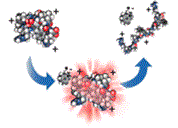
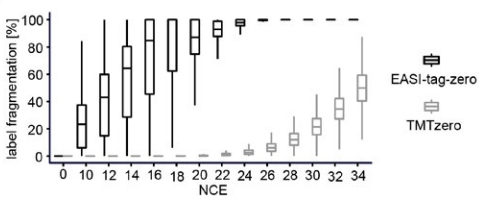
1.) EASI, which is a amine reactive TMT series utilizing sulfoxide chemisty during fragmentation. The major advantages is that EASI TMT comes off at lower collisonal energy and before the peptide backbone breaks apart, so you going to have a less complex MS2 spectra at some point.
The tricky thing here is to find an optimized setup in which the stepped normalized collisional energies provide enough fragments for determination of the peptide sequence while not losing sensitivity from your EASI reporter ions. More details you will find on the paper by Winter et al 2018.
https://www.biorxiv.org/content/early/2017/11/27/225649.full.pdf+html
The other technological improvement is called MultiNotch MS3 and was introduced by Gygi Lab from Havard in 2014 (its a bit late but I discovered it just now)
When using MultiNotch scan mode for a TMT labeled bottom-up proteomics samples MS duty cycle starts with a high resolution MS1 followed by precursor selection by the quadrupole plus mild CID fragmentation within the low resolution IT , followed by (now the magic comes into play) collection of multiple MS2 precursor with within the multipole (Thermo markets this a SPS which is basically nothing else then multiplexing on the MS2 level) and consecutive HCD to induce reporter ion generation. These fragments are finally scaned with a high resolution orbitrap mass analyis. Thats quite a duty cycle. It would be nice know the time dimensions of this impressive duty cycle!?
It is important to mention that this is only possible with unique instrumentation which allows you to apply multiple fragmentation techniques to the different levels of precusor. So that you are able to get rid of everything which breaks easily in CID and transfer your peptides entirely and still fully tagged to the MS3 stage. Since you discarded all unnecessary ions from your spectra, sensitivity is enhanced by 10-fold compared to MS2 HCD for TMT quantification. The only instrumental platform on which you can utilize such an approach is the orbitrap lumos.
Awesome technology - I love it!
One of them is chemical labelling, in which a chemical tagging structure is linked in vitro to the amine terminus (cystein or carbonyl-reactive tags are also available) of the peptides proteomewide via NHS ester reaction. To increase the throughput one can choose, depending on the method, up 11 different isotopically labeled MS tags (TMT distributed by Thermo) or up to 8 different tags for iTRAQ (distributed by ABSciex).
The major problem with these labeling strategies are co-isolated and co-fragmented peptides and their isotopes, which going to get isolated within the precursor selection window and ending up in the specific TMT or iTRAQ MS2 report ion channel. This mixed reporter ion channel is what protein scientists call ratio distortion.
Recently two approaches got introduced to the scientific community to solve this.
1.) EASI, which is a amine reactive TMT series utilizing sulfoxide chemisty during fragmentation. The major advantages is that EASI TMT comes off at lower collisonal energy and before the peptide backbone breaks apart, so you going to have a less complex MS2 spectra at some point.
The tricky thing here is to find an optimized setup in which the stepped normalized collisional energies provide enough fragments for determination of the peptide sequence while not losing sensitivity from your EASI reporter ions. More details you will find on the paper by Winter et al 2018.
https://www.biorxiv.org/content/early/2017/11/27/225649.full.pdf+html
The other technological improvement is called MultiNotch MS3 and was introduced by Gygi Lab from Havard in 2014 (its a bit late but I discovered it just now)
When using MultiNotch scan mode for a TMT labeled bottom-up proteomics samples MS duty cycle starts with a high resolution MS1 followed by precursor selection by the quadrupole plus mild CID fragmentation within the low resolution IT , followed by (now the magic comes into play) collection of multiple MS2 precursor with within the multipole (Thermo markets this a SPS which is basically nothing else then multiplexing on the MS2 level) and consecutive HCD to induce reporter ion generation. These fragments are finally scaned with a high resolution orbitrap mass analyis. Thats quite a duty cycle. It would be nice know the time dimensions of this impressive duty cycle!?
It is important to mention that this is only possible with unique instrumentation which allows you to apply multiple fragmentation techniques to the different levels of precusor. So that you are able to get rid of everything which breaks easily in CID and transfer your peptides entirely and still fully tagged to the MS3 stage. Since you discarded all unnecessary ions from your spectra, sensitivity is enhanced by 10-fold compared to MS2 HCD for TMT quantification. The only instrumental platform on which you can utilize such an approach is the orbitrap lumos.
Awesome technology - I love it!
Sonntag, 15. Juli 2018
Formic or Triflouroacetic Acid?
Additives are commonly used in LCMS. Sometimes to provide proper ionization of the analyte to ensure appropriate sensitivity or as ion pairing agent to reduce ion supression by species, that display better ionization efficiency compared to compound(s) of interest.
Two of the common additives are formic and triflouroacetic acid. Both are (semi-)volatile and have limited precipitation, which is important to maintain operation of the LCMS system.
However, when using TFA in positive mode, it will be tougher to see no ion suppression in negative mode.
Due to thier acidic properties both show ion pairing properties, although TFA has more ion pairing capacity then FA since it is a stronger acid (pKa -0.3 compared to pKa of 3.75) and therefore display more ion suppression then FA.
When it comes to LC performance TFA is more advantageous because it enhances of peak symmetry, whereas FA causes peak tailing.
To summarize the major facts one should remember:
LC - TFA over FA
ESI-MS - FA over TFA
MALDI MS - TFA over FA
Two of the common additives are formic and triflouroacetic acid. Both are (semi-)volatile and have limited precipitation, which is important to maintain operation of the LCMS system.
However, when using TFA in positive mode, it will be tougher to see no ion suppression in negative mode.
Due to thier acidic properties both show ion pairing properties, although TFA has more ion pairing capacity then FA since it is a stronger acid (pKa -0.3 compared to pKa of 3.75) and therefore display more ion suppression then FA.
When it comes to LC performance TFA is more advantageous because it enhances of peak symmetry, whereas FA causes peak tailing.
To summarize the major facts one should remember:
LC - TFA over FA
ESI-MS - FA over TFA
MALDI MS - TFA over FA
Scoville Scale - Determination of pungency of chilli sauces
A few weeks ago I have been to a spice museum and beside all these flavours and odurs in the air their have been a section decidated for chili peppers and chilli sauce only.
At the exhibition different pepper types have been introduced to the vistor, among them the TOP 3 on the scoville scale. The scoville scale is a scale to determine the spiciness of chilli peppers in SHU scoville heat units. It ranges from 0 to 16.000.000 SHU. With 0 being no pungency at all and 16.000.000 being the highest.
The scale is based on the qualitative principle of diluting the chilli sauce with water and let selected probands taste it and let them determine the pungency present. Because this was a really subjective way (sometimes variances of about +/-50%) and not really scaleable approach the chilli pepper industry abandoned this test at some point.
And this is where LCMS comes into play. Chilli peppers belong to the taxomonic family as potatos, eggplant and deadly nightshade - they are solanaceae. A plant family which is known to syntheses alkaloids. The pungency of chilli peppers is proportionally related to endgoneous alkaloid capsaicin/dihydrocapsaicin and it's concentration can be determined with LCMS. After successfull identification and quantification the capsaicin concentations can be converted (multiplying them with a factor of 15) to SHU. A really nice way to relate and appreciate former achivement and traditions in the field.
At the exhibition different pepper types have been introduced to the vistor, among them the TOP 3 on the scoville scale. The scoville scale is a scale to determine the spiciness of chilli peppers in SHU scoville heat units. It ranges from 0 to 16.000.000 SHU. With 0 being no pungency at all and 16.000.000 being the highest.
The scale is based on the qualitative principle of diluting the chilli sauce with water and let selected probands taste it and let them determine the pungency present. Because this was a really subjective way (sometimes variances of about +/-50%) and not really scaleable approach the chilli pepper industry abandoned this test at some point.
And this is where LCMS comes into play. Chilli peppers belong to the taxomonic family as potatos, eggplant and deadly nightshade - they are solanaceae. A plant family which is known to syntheses alkaloids. The pungency of chilli peppers is proportionally related to endgoneous alkaloid capsaicin/dihydrocapsaicin and it's concentration can be determined with LCMS. After successfull identification and quantification the capsaicin concentations can be converted (multiplying them with a factor of 15) to SHU. A really nice way to relate and appreciate former achivement and traditions in the field.
Lectures of MaxQuant Summer School
It's summertime that means it's time for MaxQuant Summer School. For the 10th time proteomics research gather to get to know the hints and tricks about dealing with proteomics software maxQuant.
Over the time span of a decade MaxQuant have become the leading software for shotgun proteomics and quantification via Lable-Free-Quantification, Tandem-Mass-Tag and SILAC.
Briefly, MaxQuant consists of a search engine Andromeda, which is similar to mascot or crux and a visualization tool, called Perseus which provides comprehensive statistical analysis, such as normalization and hypothesis testing.
https://www.youtube.com/watch?v=tAihiwLhzHc
For more detailed information about the specific feature of MaxQuant check out the great youtube channel, to which all the lecture of current and former summer schools are uploaded.
micro pillar array - the future of chromatography?!
Nowadays, high sensitivity LCMS requires nanoLC in front of a state of the art mass spec. However, these nanoLC-MS systems need to be maintained intensively to avoid downtimes (due to column clogging), especially when analyzing an high number of samples.
This means improving robustness and performance of nanoLC are a major objective in academia and industry.
While skiming to keynote lecture of the MaxQuant Summer School the invention of micro chip pillar array column as chromatographic device integrated into LCMS setup was mentioned.
In my optinion these chips offer a great opportunity to overcome the limits of traditional nanoLC since they eliminate the column specific eddy dispersion and display incrediable low backpressure at column length of up to 2m.
I took this picture from the introductional video...really impressive and worth watching https://vimeo.com/230455032
I try to find out how these chips are manufactured. Which brought me to an belgian company called pharmafluidics.
https://www.pharmafluidics.com/
By the way for the people out there seeking for a new challenge they have open job vacancies currently. But back to the micro pillar chips - They are made of silicon pillars which are the result of an etching process which removes the interstitial volume in a really reproducible and homogeneous manner. These manufacturing methods have been successfully applied in the semiconductor industry. I am really looking forward to read studies evaluting proteomics performance of these chips.
This means improving robustness and performance of nanoLC are a major objective in academia and industry.
While skiming to keynote lecture of the MaxQuant Summer School the invention of micro chip pillar array column as chromatographic device integrated into LCMS setup was mentioned.
In my optinion these chips offer a great opportunity to overcome the limits of traditional nanoLC since they eliminate the column specific eddy dispersion and display incrediable low backpressure at column length of up to 2m.
I took this picture from the introductional video...really impressive and worth watching https://vimeo.com/230455032
I try to find out how these chips are manufactured. Which brought me to an belgian company called pharmafluidics.
https://www.pharmafluidics.com/
By the way for the people out there seeking for a new challenge they have open job vacancies currently. But back to the micro pillar chips - They are made of silicon pillars which are the result of an etching process which removes the interstitial volume in a really reproducible and homogeneous manner. These manufacturing methods have been successfully applied in the semiconductor industry. I am really looking forward to read studies evaluting proteomics performance of these chips.
Abonnieren
Posts (Atom)